About Me

My photo
Lift your lamp beside the golden door, Break not the golden rule, avoid well the golden calf, know; not all that glitters is gold, and laissez faire et laissez passer [let do and let pass] but as a shining sentinel, hesitate not to ring the bell, defend the gates, and man the wall

Tell Me What Democracy Looks Like!

Tell Me What Democracy Looks Like! THIS IS WHAT DEMOCRACY LOOKS LIKE!!!

Cycle of Democracies

overview of what various forms of Govt.

Monday, February 28, 2011

Barack Hussein Obama


born August 4, 1961) is the 44th and current President of the United States. He is thefirst African American to hold the office. Obama previously served as a United States Senator from Illinois, from January 2005 until he resigned after his election to the presidency in November 2008.
A native of Honolulu, Hawaii, Obama is a graduate of Columbia University and Harvard Law School, where he was the president of the Harvard Law Review. He was a community organizer in Chicago before earning his law degree. He worked as a civil rights attorney in Chicago and taught constitutional law at the University of Chicago Law School from 1992 to 2004.
Obama served three terms in the Illinois Senate from 1997 to 2004. Following an unsuccessful bid against the Democratic incumbent for a seat in theU.S. House of Representatives in 2000, he ran for United States Senate in 2004. Several events brought him to national attention during the campaign, including his victory in the March 2004 Democratic primary and his keynote address at the Democratic National Convention in July 2004. He won election to the U.S. Senate in November 2004. His presidential campaign began in February 2007, and after a close campaign in the 2008 Democratic Party presidential primaries against Hillary Rodham Clinton, he won his party's nomination. In the 2008 general election, he defeated Republican nominee John McCain and was inaugurated as president on January 20, 2009.
As president, Obama signed economic stimulus legislation in the form of the American Recovery and Reinvestment Act in February 2009 and the Tax Relief, Unemployment Insurance Reauthorization, and Job Creation Act of 2010 in December 2010. Other domestic policy initiatives include the Patient Protection and Affordable Care Act, the Dodd–Frank Wall Street Reform and Consumer Protection Act and the Don't Ask, Don't Tell Repeal Act of 2010. In foreign policy, Obama gradually withdrew combat troops from Iraq, increased troop levels in Afghanistan, and signed an arms control treaty withRussia. In October 2009, Obama was named the 2009 Nobel Peace Prize laureate.


__________________________________________________________________________________

W.I.P. got the subjects for starters
__________________________________________________________________________________

Barack Hussein Obama Sr.


__________________________________________________________________________________

The Red Childhood of Berry Sotoro

Anti-Colonialism [Tortured Grandfather]

Race and Life


__________________________________________________________________________________

Barack; Fitting In, In College

Drug Use
_______________________________________________________

Senior Lecturer


In most English-speaking nations professor is a title reserved for a senior academic who holds a departmental chair (especially as head of the department), or a personal chair awarded specifically to that individual. However, in the United States and Canada the title of professor is given to a much larger group of senior teachers in two- and four-year colleges and universities.


__________________________________________________________________________________


Community Organizing, Eschewing Ayers and Chicago Politics

Palmer

__________________________________________________________________________________
2001 Interview on Chicago Public Radio 91.5 FM


Obama: “You know if if if you look at um, the the victories and failures of the civil rights movement, um, and its litigation strategy in the court, I think where it succeeded was to vest formal rights uh, in uh previously dispossessed peoples, so that uh, I would now have the right to vote, I would now be able to sit at a lunch counter and order and as long as I could pay for it I’d be okay. Ah But, the Supreme Court never ventured into the issues of redistribution of wealth uh and sort of more basic issues of political and economic justice in this society. And uh to that extent as radical as I think people tried to characterize the Warren Court, ah, it wasn’t that radical. It didn’t break free from uh, the essential constraints that were placed by the ah founding fathers in the Constitution, as least as it’s been interpreted, and Warren Court interpreted in the same way that generally the Constitution is a charter of negative liberties, says what the states can’t do to you, says what the federal government can’t do to you, but it doesn’t say what the federal government or the state government must do on your behalf uh And that hasn’t shifted and one of the, uh I think, uh one of the tragedies of the civil rights movement, was because the civil rights movement became so court focused, I think that there was a tendency to lose track of the political and community organizing and and activities on the ground that are able to put together the actual coalitions of power through which you bring about redistributive ah change, ah and uh in some ways we still suffer from that.”
Caller: Hi, um, the gentleman made the point that the warren court wasn't uh terribly radical, my question is, um with economic changes, my question: is it too late for that kind of reparative work, economically and is that the appropriate place for reparative economic work to take place?

Interviewer: You mean the court?

Caller: The court, or would it be legislation at this point?
Obama: uh uh uh, you know uh, maybe I'm showing my bias here, here as a legislator, as well as a law professor, but uh, you know, I-I'm not optimistic about bringing about, uh, a major, uh, redistributive uh, change, uh, through the courts. um you know the institution just isn't structured that way uh..." -- "Um, you-you-you just um-ould look at very rare examples where you know the desegregation era the court was willing to-uh order uh uh you know changes that cost money to a-h local school district; the court was very uncomfortable with it, it was hard to manage it was hard to figure out ah, you start getting into all sorts of ah-separations of powers issues, uh-you know, in terms of uh-the court monitoring or-or-or engaging in a process uh, that essentially is administrative and takes a-a lot of time..." -- "Um, you know-a-the courts just not very good at it and politically its just-its very hard to legitimize opinions from the court-so I may-I think that, although you can craft theoretical justifications for it legally-um-you know,-I think you can-any-any three of us sitting here could come up with uh, a rationale for bringing about economic change through the courts..."


__________________________________________________________________________________

Progressivism and SEIU
__________________________________________________________________________________


Bail Out [Under Bush]
__________________________________________________________________________________

Being Sworn In, Obama's Oath of Office
__________________________________________________________________________________

Children's Health Insurance Program Reauthorization Act (CHIP)
__________________________________________________________________________________

The "Stimulus" Bill, aka ARRA 
The American Recovery and Reinvestment Act ( $787 billion, and almost $1.2 trillion with debt service included)

Tripling The Debt
__________________________________________________________________________________

Bowing
__________________________________________________________________________________

Obama-Care, Pelosi-Care, Health Care "Reform"

[Nationally Socialized Health Care] 'Reform"

__________________________________________________________________________________

Financial "Reform" Bill 

[LAW]

FINANCIAL BILL HR 4173 Dodd–Frank Wall Street Reform and Consumer Protection Act
___

http://www.sec.gov/about/laws/wallstreetreform-cpa.pdf

http://business.cch.com/briefings/FinancialReformBill.pdf
___

2300 page bill [in its final form]
___

1. Does nothing about Fannie & Freddie; no regulation on them

2. Creates "Too Big To Fail" Protection Class: Sec 113; A Financial Stability Oversight Committee will choose the firms deemed "too big to fail"

3. Seizure of private property "without meaningful judicial review" Secretary of Treasury can order the seizure of any financial firm "In danger of default" that could hurt the country's economy

4. Creates a Bureau of Consumer Financial Protection [BCFP]: Which will have broad powers to limit what financial products and services can be offered to consumers

[Reduces options, limits credit] [Track transactions] Section 102 defines "A nonbank financial company [as] substantially engaged in activities in the United States that are financial in nature"

Obama Signed, July 21st 2010
___

Version as of April 22nd 2010 -
http://www.heritage.org/research/reports/2010/04/senator-dodds-regulation-plan-14-fatal-flaws

Financial Regulation Reform (Bill that Passed the Senate) -Heritage Foundation-

Section 102(B)(ii) of the bill defines a “nonbank financial company”” as a company “substantially engaged in activities … that are financial in nature.” The phrase “financial in nature” is defined in existing law quite broadly. According to former Treasury official Gregory Zerzan, it includes things such as “holding assets of others in trust, investing in securities … or even leasing real estate and offering certain consulting services.”[5] As a result, a broad swath of private industry may find itself ensnared in the financial regulatory net. As Zerzan explains: “An airplane manufacturer that holds customer down payments for future delivery, a large home improvement chain that invests its profits as part of a plan to increase revenues, and an energy firm that makes markets in derivatives are all engaged in ‘financial activities’ and potentially subject to systemic risk regulation.”

__________________________________________________________________________________

Net Neutrality
__________________________________________________________________________________

Extending Bush Tax Cuts vs Obama Tax Hikes

__________________________________________________________________________________

http://www.whitehouse.gov/briefing-room/signed-legislation?page=36
__________________________________________________________________________________
America would not be "Great" without Entitlements 
April 14, 2011 at 7:49 am - CNS News Dateline: Washington DC


________________________________________________________________

Obama's FALSE Claims that Chrystler Repaid "Every Dime It Owes" June 4th 2011

http://www.washingtonpost.com/blogs/fact-checker/post/president-obamas-phony-accounting-on-the-auto-industry-bailout/2011/06/06/AG3nefKH_blog.html

________________________________________________________________
 

WIP WIP WIP

She was a good-looking woman, Joyce was with her green eyes and honey skin and pouty lips. We lived in the same dorm my freshman year, and all the brothers were after her. One day I asked her if she was going to the Black Students' Association meeting. She looked at me funny, then started shaking her head like a baby who doesn't want what it sees on the spoon.
"I'm not black," Joyce said. "I'm multiracial." Then she started telling me about her father, who happened to be Italian and was the sweetest man in the world; and her mother, who happend to be part African and par French and part Native American and part something else. "why should I have to choose between them?" she asked me. Her voice cracked and I thought she was going to cry. "It's not white people who are making me choose. Maybe it used to be that way, but now they're willing to treat me like a person. No - it's black people who always have to make everything racial. They're the ones making me choose. They're the ones who are telling me that I can't b who I am ..."
They, they, they. That was the problem with people like Joyce. They talked about the richness of their multicultural heritage and it sounded real good, until you noticed that they avoided black people...
To avoid being mistaken for a sellout, I chose my friends carefully. The more politically active black students. The foreign students. The Chicanos. The Marxist professors and structural feminists and punk-rock performance poets. We smoked cigarettes and wore leather jackets. At night, in the dorms, we discussed necolonialism, Franz Fanon, Eurocentrism, and patriarchy. When we ground out our cigarettes in the hallway carpet or set our stereos so loud that the walls began to shake, we were resisting bourgeois society’s stifling constraints. We weren’t indifferent or careless or insecure. We were alienated.  But this strategy alone couldn’t provide the distance I wanted, from Joyce or my past. After all, there were thousands of so-called campus radicals, most of them white and tenured and happily tolerated. No, it remained necessary to prove which side you were on, to show your loyalty to the black masses, to strike out and name names." Page 101 of Dreams From My Father


"Dreams from My Father" [pg. 220]: Yes, I’d seen weakness in other men – Gramps and his disappointments, Lolo and his compromise. But these men had become object lessons for me, men I might love but never emulate, white men and brown men whose fates didn’t speak to my own. It was into my father’s image, the black man, son of Africa, that I’d packed all the attributes I sought in myself, the attributes of Martin and Malcolm, DuBois and Mandela. And if later I saw that the black men I knew – Frank or Ray or Will or Rafiq – fell short of such lofty standards; if I had learned to respect these men for the struggles they went through, recognizing them as my own – my father’s voice had nevertheless remained untainted, inspiring, rebuking, granting or withholding approval.  You do not work hard enough, Barry. You must help in your people’s struggle. Wake up, black man!


When people who don’t know me well, black or white, discover my background (and it is usually a discovery, for I ceased to advertise my mother’s race at the age of twelve or thirteen, when I began to suspect that by doing so I was ingratiating myself to whites), I see the split-second adjustments they have to make, the searching of my eyes for some telltale sign. They no longer know who I am. Privately, they guess at my troubled heart, I suppose – the mixed blood, the divided soul, the ghostly image of the tragic mulatto trapped between two worlds. And if I were to explain that no, the tragedy is not mine, or at least not mine alone, it is yours, sons and daughters of Plymouth Rock and Ellis Island, it is yours, children of Africa, it is the tragedy of both my wife’s six-year-old cousin and his white first grade classmates, so that you need not guess at what troubles me, it’s on the nightly news for all to see, and that if we could acknowledge at least that much then the tragic cycle begins to break down…well, I suspect that I sound incurably naive, wedded to lost hopes, like those Communists who peddle their newspapers on the fringes of various college towns. Or worse, I sound like I’m trying to hide from myself.
Dreams from My Father pg. xv

http://www.snopes.com/politics/obama/coilofrage.asp

http://factcheck.org/2008/06/obamas-dreams-of-my-father/


Wednesday, February 23, 2011

Cass Sunstein

Cass Sunstein

Conspiracy Theories: Causes and Cures [PDF Link SOURCE]
Cass Sunstein and Adrian Vermeule - 2010

"What can government do about conspiracy theories? Among the things it can do, what should it do?
(1) Government might ban "conspiracy theories", somehow defined. 
(2) Government might impose some kind of tax, financial or otherwise, on those who disseminate such theories. 
(3) Government might itself engage in counterspeech, marshaling arguments to discredit conspiracy theories. 
(4) Government might formally hire credible private parties to engage in counterspeech. 
(5) Government might engage in informal communication with such parties, encouraging them to help. Each instrument has a distinctive set of potential effects, or costs and benefits, and each will have a place under imaginable conditions.  
Our main policy claim here is that government should engage in cognitive infiltration of the groups that produce conspiracy theories, which involves a mix of (3), (4), and (5)."


Media Matters claims full quote exonerates Cass and Adrian(in bold) when it only further damns them while OBVIOUSLY leaving a giant loop hole with the phrase "Our main policy claim here" duh, (They also claim Glenn Beck "Cropped" the quote, he read it in full on the radio where he has 3 hours not 1)
 

From The First Page of "Nudge" 


"There's a little Homer Simpson in all of us. Sometimes we have self-control problems, sometimes we're impulsive and that in these circumstances, both private and public institutions, without coercing, can make our lives a lot better. Once we know that people are human and have some Homer Simpson in them, then there's a lot that can be done to manipulate them."
    

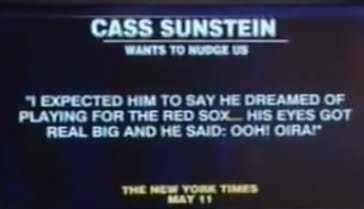
Sunstein's Wife asked (when they were dating) what his dream job would be... (The OIRA is the Office Of Information And Regulatory Affairs)

"I expected him to say he dreamed of playing for the Red Sox... his eyes got real big and he said: OOH! O.I.R.A. !" -NYT may 11


__________________________________________________________________________________


__________________________________________________________________________________
Samantha Power; wife of Cass Sunstein,

Advocate of the "Responsibility to Protect" policy


________________________________________
The Most Dangerous Woman In America?  
[Glenn Beck] Wednesday, March 30, 2011

________________________________________


Samantha Power Goes to War by Tom Haydenvia The Nation


Excerpt-

Over a long conversation with Power in December 2003, I was struck by the generational factor in her thinking. If she had experienced Vietnam in her early 20s, I felt, she would have joined the radical left, suspicious always of American power. But as an Irish internationalist witnessing death and destruction in the former Yugoslavia, she wondered how the United States could be neutral. She strongly favored the American intervention and air war that followed. I asked whether she would have favored the Clinton administration sending combat troops to battle the Serbs, a scenario which was in the works when Russia pulled its support from Belgrade, effectively ending that war. I didn’t get an answer, only the promise of “a long conversation” in the future.
Power generalized from her Balkans experience to become an advocate of American and NATO military intervention in humanitarian crises, a position which became known as being a “humanitarian hawk.” She began to see war as an instrument to achieving her liberal, even radical, values. “The United States must also be prepared to risk the lives of its soldiers” to stop the threat of genocide, she wrote. She condemned Western “appeasement” of dictators. She believed that “the battle to stop genocide has been repeatedly lost in the realm of domestic politics.” In her mind, domestic concerns like discrimination and unemployment were secondary to foreign policy crises, a common attitude in the national security circles she was entering.

________________________________________________________________________________
Glenn Beck Show- March 24, 2011
19:10-19:45 - Open Society - defined
20:10 precursor - 21:35 Responsibility to Protect - explained
22:43 Samantha Power - "The Problem from Hell"


________________________________________________________________________________

http://www.freerepublic.com/focus/f-bloggers/2695917/posts________________________________________________________________________________

"Responsibility To Protect" [Wikipedia]

________________________________________________________________________________


Thursday, February 3, 2011

Theodore Roosevelt

Teddy
 Theodore Roosevelt, became President by the assassination of William McKinley, and held office from 1901-1909. He initiated the "Progressive Movement". Modern politics finds much of its origin in the progressive rejection of the principles and constitutionalism of our founding fathers.

TR was the first to use the presidency to promote particular domestic policy initiatives, which originated the term "Bully Pulpit". A perfect example of which is his promotion of the Hepburn Act.
 After his presedincy, he embraced even more, Progressive principles, regarding the role of government; influenced by HerbertCroly and his book The Promise of American Life. Which compelled him to run for president in 1912, and his progressive party platform.

In the mid 1800s, Progressivism was imported from German universities, that were under the influence of Immanuel Kant and Georg Hegel [who articulated ideas of sharp contrast to those of our founding], by German and American students to American universities, beginning with Johns Hopkins University, which established the first graduate program in political science in the US.
Throughout the late 1800s and early 1900s, Progressive Ideas flooded into the mainstream academia as well as culture through Muck Raking Journalism, and the rise of Magazines.
 
___________________________________________________________________________________
[Wikipedia] [Conservapedia]

Corollary to the Monroe Doctrine (1905) - [OurDocuments.gov]
___________________________________________________________

W.I.P.

The Elkins Anti-Rebate Law,
the Department of Commerce,

Hepburn Bill.

National Forest Service -   · The National Forest Service was created during Roosevelt's Presidency to protect and help conserve the National Forests and National Parks in the United States. The service's creation is one example of Roosevelt's policies concerning conservation.
__________________________________________________________________________________


_____________
Quotes:

“The man who wrongly holds that every human right is secondary to his profit must now give way to the advocate of human welfare, who rightly maintains that every man holds his property subject to the general right of the community to regulate its use to whatever degree the public welfare may require it."

"Combinations in industry are the result of an imperative economic law which cannot be repealed by political legislation. The effort at prohibiting all combination has substantially failed. The way out lies, not in attempting to prevent such combinations, but in completely controlling them in the interest of the public welfare."

"Every special interest is entitled to justice full, fair, and complete and, now, mind you, if there were any attempt by mob-violence to plunder and work harm to the special interest, whatever it may be, that I most dislike, and the wealthy man, whomsoever he may be, for whom I have the greatest contempt, I would fight for him, and you would if you were worth your salt. He should have justice. For every special interest is entitled to justice, but not one is entitled to a vote in Congress, to a voice on the bench, or to representation in any public office. The Constitution guarantees protection to property, and we must make that promise good. But it does not give the right of suffrage to any corporation. "


__________________________________________
Theodore "Teddy" Roosevelt's The Man In The Arena Speech at the Sorbonne April 23 1910
Theodore "Teddy" Roosevelt's New Nationalism Aug 31, 1910

______________________

New Nationalism - [blog-LINK]
__________________________________________
The Meat Inspection Act - [blog-LINK]
____________________________________________________________
____________________________________________________________


____________________________________________________________

____________________________________________________________

Friday, December 17, 2010

Nazism

Adolf Hitler
(April 20 1889 – April 30 1945) 
An Austrian-born German politician and the leader of NSDAP, The "Nationalsozialistische Deutsche Arbeiterpartei" or "National Socialist German Workers Party" more commonly known as the Nazi Party.
He was Chancellor of Germany from 1933 to 1945, and from 1934 to 1945 Führer und Reichskanzler.

A decorated veteran of World War I, Hitler joined the precursor of the Nazi Party The DAP, "Deutsche Arbeiterpartei" or "German Workers' Party" in 1919, and became leader of Nazy Party, in 1921. He attempted a failed coup d'etat known as the Beer Hall Putsch, which occurred at the Bürgerbräukeller beer hall in Munich on November 8–9, 1923.

Hitler was imprisoned for one year due to the failed coup, and wrote his memoir, Mein Kampf, while imprisoned. After his release on December 20, 1924, he gained support by promoting Pan-Germanism, anti-semitism, anti-capitalism, and anti-communism with charismatic oratory and propaganda. He was appointed chancellor on January 30, 1933, and transformed the Weimar Republic into the Third Reich, a single-party dictatorship based on the totalitarian andautocratic ideology of Nazism.

Hitler ultimately wanted to establish a New Order of absolute Nazi German hegemony in continental Europe. To achieve this, he pursued a foreign policywith the declared goal of seizing Lebensraum ("living space") for the Aryan people; directing the resources of the state towards this goal. This included the rearmament of Germany, which culminated in 1939 when the Wehrmacht invaded Poland. In response, the United Kingdom and France declared war against Germany, leading to the outbreak of World War II in Europe.[2]

Within three years, German forces and their European allies had occupied most of Europe, and most of Northern Africa, and the Japanese forces had occupied parts of East and Southeast Asia and the Pacific Ocean. However, with the reversal of the Nazi invasion of the Soviet Union, the Allies gained the upper hand from 1942 onwards. By 1944, Allied armies had invaded German-held Europe from all sides. Nazi forces engaged in numerous violent acts during the war, including the systematic murder of as many as 17 million civilians,[3] including an estimated six million Jews targeted in the Holocaust and between 500,000 and 1,500,000 Roma,[4] added to the Poles, Soviet civilians, Soviet prisoners of war, people with disabilities, homosexuals, Jehovah's Witnesses, and other political and religious opponents.

In the final days of the war, during the Battle of Berlin in 1945, Hitler married his long-time mistress Eva Braun and, to avoid capture by Soviet forces, the two committed suicide[5] less than two days later on 30 April 1945.
________________________________________________________________________________

Godwin's Law

Reductio ad Hitlerum:

______________________________________________
Quotes

"The best thing is to let Christianity die a natural death...."

"Our epoch Uin the next 200 yearse will certainly see the end of the disease of Christianity.... My regret will have been that I couldn't..."

here's a hitler youth chant "We are the joyous Hitler youth, We do not need any Christian virtue"
______________________________________________________________________________

a press release from Catholic League President, William A. Donohue (2/4/99): "Hitler was a neo-pagan terrorist whose conscience was not informed by Christianity, but by pseudo-scientific racist philosophies. Hitler hated the Catholic Church, made plans to kill the Pope, authorized the murder of thousands of priests and nuns, and did everything he could to suppress the influence of the Church. In 1933, Hitler said, 'It is through the peasantry that we shall really be able to destroy Christianity because there is in them a true religion rooted in nature and blood.'"  The Catholic League also quoted Hitler, in a 4/23/99 Op-Ed ad in the New York Times, as saying, "Antiquity was better than modern times, because it didn't know Christianity and syphilis." Ouch!

Hitler: A Study in Tyranny, by Allan Bullock, as saying: "I'll make these damned parsons feel the power of the state in a way they would have never believed possible. For the moment, I am just keeping my eye upon them: if I ever have the slightest suspicion that they are getting dangerous, I will shoot the lot of them. This filthy reptile raises its head whenever there is a sign of weakness in the State, and therefore it must be stamped on. We have no sort of use for a fairy story invented by the Jews."

Hitler's secretary, Martin Bormann, also declared that "National Socialism [Nazism] and Christianity are irreconcilable" and Hitler didn't squawk too much about it.

Hermann Rauschning, a Hitler associate, said, "One is either a Christian or a German. You can't be both."

Hitler declared Nazism the state religion and the Bible was replaced by Mein Kampf in the schools.
__________________________________________________________________________

http://homepages.paradise.net.nz/mischedj/ca_hitler.html

Friday, November 12, 2010

George Soros

Wikipedia: George Soros

Discover The Networks: George Soros
  • Multi-billionaire funder of leftwing causes and groups
  • Founder of the Open Society Institute  
  • Stated that defeating President Bush in the 2004 election "is the central focus of my life"

http://www.theblaze.com/stories/the-puppet-master-read-the-beck-tv-background-guide-to-george-soros/


Soros Quotes:
 "It is sort of a disease when you consider yourself some kind of god, the creator of everything, but I feel comfortable about it now since I began to live it out." The Independant June 3, 19X3

Sunday, October 17, 2010

Depressions

The Long Depression, The Depression of 1920, The Great Depression, and The Great Recession 
__________________________________________________________________________________
_______________________________________
The Long Depression
The Original "Great Depression" 1873-1896 
_____________________________________________________________
History of Money and Banking in the United States by Murray Rothbard [free PDF ebook]
[This refers solely to America]
pg 154
Orthodox economic historians have long complained about the “great depression” that is supposed to have struck the United States in the panic of 1873 and lasted for an unprecedented six years, until 1879. Much of this stagnation is supposed to have been caused by a monetary contraction leading to the resumption of specie payments in 1879. Yet what sort of “depression” is it which saw an extraordinarily large expansion of industry, of railroads, of physical output, of net national product, or real per capita income? As Friedman and Schwartz admit, the decade from 1869 to 1879 saw a 3-percent-perannum increase in money national product, an outstanding real national product growth of 6.8 percent per year in this period, and a phenomenal rise of 4.5 percent per year in real product per capita. Even the alleged “monetary contraction” never took place, the money supply increasing by 2.7 percent per year in this period. From 1873 through 1878, before another spurt of monetary expansion, the total supply of bank money rose from $1.964 billion to $2.221 billion—a rise of 13.1 percent or 2.6 percent per year. In short, a modest but definite rise, and scarcely a contraction. It should be clear, then, that the “great depression” of the 1870s is merely a myth—a myth brought about by misinterpretation of the fact that prices in general fell sharply during the entire period. Indeed they fell from the end of the Civil War until 1879. Friedman and Schwartz estimated that prices in general fell from 1869 to 1879 by 3.8 percent per annum. Unfortunately, most historians and economists are conditioned to believe that steadily and sharply falling prices must result in depression: hence their amazement at the obvious prosperity and economic growth during this era. For they have overlooked the fact that in the natural course of events, when government and the banking system do not increase the money supply very rapidly, freemarket capitalism will result in an increase of production and economic growth so great as to swamp the increase of money supply. Prices will fall, and the consequences will be not depression or stagnation, but prosperity (since costs are falling, too) economic growth, and the spread of the increased living standard to all the consumers.
http://blog.mises.org/13120/krugman-and-the-long-depression-myth/ 
_______________________________________________________

http://blog.mises.org/9790/the-truth-about-the-depression-of-the-1870s/
http://mises.org/Community/forums/t/18479.aspx

http://mises.org/daily/3788
http://en.wikipedia.org/wiki/Long_Depression
__________________________________________________________________________________
The Depression of 1920


__________________________________________________________________________________
______________________________________
The Great Depression

Great Depression Playlist


[Uncommon_Knowledge_Amity_Shlaes]


[Amity_Shlaes_A_New_History_of_the_Great_Depression]
 
____________________________________________________
 
The Forgotton Man by Amity Shlaes [Excerpts Thereof]

Title Page, The Forgotten Man Essay by William Graham Sumner
pg 1, Introduction: William Troeller, just one story, in a city of troubled stories.
pg 99-100, Herbert Hoover, Richard Whitney, and Short Selling, an essential gamble

____________________________________________________


The Global Impact of the Great Depression, 1929-1939 by Dietmar Rothermund [Google Books.com]

THE TRANSMISSION OF THE CRISIS TO EUROPE pg 59
The depression was transmitted from America to Europe in 1930. The stock market crash of October 1929 did not have an immediate effect on Europe. On the contrary, financial circles could heave a sigh of relief as they were no longer threatened by the rush of funds to New York. Discount rates which had been raised to counteract that flow could be lowered once more and this eased the strain on European financial markets. From 1925 to the beginning of 1929 the discount rate of the Bank of England had stood at about 4.5 per cent. By September 1929 it had been raised to 6.5 per cent. Immediately after the crash it was reduced to 6 per cent. It was then lowered bit by bit until it stood at 2.5 per cent in May 1931. In France a new generous programme of state expenditure was announced only a few weeks after the crash. But this was not done in wise anticipation of the impending crisis, but only because France had consolidated its currency and was in a very comfortable financial position. It could afford such a programme now, and nobody thought of a crisis.
Germany faced an impending bankruptcy at that time which was entirely unrelated to the events in America. The German government was under political pressure to cut taxes, but on the other hand it could no longer place long term government bonds and thus depended on short term credit. In this context the lowering of the discount rate after the crash was very welcome to the government. In subsequent years Germany faced a crisis of a special kind which will be analysed in the respective section of this chapter. At this stage these statements may suffice to show that the crash of 1929 did not mark the beginning of the depression in Europe. The mechanism of the transmission of the depression was much more complex. Europe was affected only after a considerable... [continued on page 60] -
time lag. In order to reconstruct the process of transmission we shall present four case studies: Great Britain, Germany, France and Sweden, the latter so as to illustrate a very special instance of successful crisis management.
______________________________
Henry Morgenthau, Jr. [Wikipedia]
FDR's Treasury Secretary

"We have tried spending money. We are spending more than we have ever spent before and it does not work. And I have just one interest, and if I am wrong … somebody else can have my job. I want to see this country prosperous. I want to see people get a job. I want to see people get enough to eat. We have never made good on our promises. … I say after eight years of this Administration we have just as much unemployment as when we started. … And an enormous debt to boot."
__________________________________________________________________________________
The Great Recession

Liberty and Tyranny by Mark R. Levin Excerpts 

pg82
__________________________________________________
   A. What belongs to no one is wasted by everyone
   B. Statist's rationalizing Loophole around property rights
       "The Public Good"
Four Events that led to the Housing Bust of '08 
   EVENT 1: The CRA of 1977
__________________________________________________

____________________________________________________
EVENT 2: HUD pressures Govt Chartered Freddie and Fannie to encourage risky loans
   EVENT 3: Govt Intervention/Social Engineering produces the "Derivative"/Speculation Market 
   EVENT 4: The Federal Reserve slashes interest rates from 2001's at 6.5% to 2006's at 1%
 ____________________________________________________

________________________________________________________________________________

The Scope of the Bailout/Stimulus


______________________________________________________________________________

http://youtu.be/MAewKx7wx0c


http://goo.gl/XbQKI
 
______________________________________________________________________________
______________________________________________________________________________

The Inflationist View of History -http://mises.org/daily/4143 
______________________________________________________________________________
After having skimmed these sources to respond to a comment; now I actually need to do my homework; which is to organize this into comprehensive knowledge for reference [IE my own memory trigger/vault]

http://en.wikipedia.org/wiki/Herbert_Hoover#Great_Depression

http://mises.org/daily/3788

http://en.wikipedia.org/wiki/Herbert_Hoover#Great_Depression

http://www.federalreserve.gov/boarddocs/speeches/2004/200403022/default.htm

http://en.wikipedia.org/wiki/Great_Depression#Effects

http://en.wikipedia.org/wiki/Depression_of_1920%E2%80%9321#Monetary_policy

http://www.youtube.com/watch?v=9V5OP-VmXgE

http://en.wikipedia.org/wiki/Depression_of_1920%E2%80%9321#Monetary_policy
___________________________
__________________________________________________________________________________

Fannie, Freddie, and the Subprime Mortgage Market

http://www.cato.org/pub_display.php?pub_id=12846

Friday, August 20, 2010

The Union of Soviet Socialist Republics

The Soviet Union (Wikipedia)

Communism (Wikipedia)

Leninism (Wikipedia)

Stalinism (Wikipedia)

The Soviet Holocaust

"The Revolutionary Holocaust" via WatchGlennBeck.com

"The Soviet Story" via Viddler.com

Constitutions of USSR
The Brezhnev Constitution (InBlog)

Belavezha Accords (Wikipedia)
__________________________________________________________________________________
______________________________________________________

BOOKS
______________


Communist Manifesto by Karl Marx and Frederick Engels (Free Online eBook)


Blacklisted by History: The Untold Story of Senator Joe McCarthy by M. Stanton Evans


The Dead Hand: The Untold Story Of The Cold War Arms Race And Its Dangerous Legacy by David E. Hoffman


Know Your Enemy: The Rise and Fall of America's Soviet Experts by David C. Engerman


Lenin, Stalin, And Hitler by Robert Gellately


THE RED NETWORK; A "WHO'S WHO" AND HANDBOOK OF RADICALISM FOR PATRIOTS by Elizabeth Kirkpatrick Dilling 1894-1966 (Free eBook)


Soviet Fates And Lost Alternatives by Stephen F. Cohen


_________________