About Me

My photo
Lift your lamp beside the golden door, Break not the golden rule, avoid well the golden calf, know; not all that glitters is gold, and laissez faire et laissez passer [let do and let pass] but as a shining sentinel, hesitate not to ring the bell, defend the gates, and man the wall

Tell Me What Democracy Looks Like!

Tell Me What Democracy Looks Like! THIS IS WHAT DEMOCRACY LOOKS LIKE!!!

Cycle of Democracies

overview of what various forms of Govt.

Wednesday, February 23, 2011

Cass Sunstein

Cass Sunstein

Conspiracy Theories: Causes and Cures [PDF Link SOURCE]
Cass Sunstein and Adrian Vermeule - 2010

"What can government do about conspiracy theories? Among the things it can do, what should it do?
(1) Government might ban "conspiracy theories", somehow defined. 
(2) Government might impose some kind of tax, financial or otherwise, on those who disseminate such theories. 
(3) Government might itself engage in counterspeech, marshaling arguments to discredit conspiracy theories. 
(4) Government might formally hire credible private parties to engage in counterspeech. 
(5) Government might engage in informal communication with such parties, encouraging them to help. Each instrument has a distinctive set of potential effects, or costs and benefits, and each will have a place under imaginable conditions.  
Our main policy claim here is that government should engage in cognitive infiltration of the groups that produce conspiracy theories, which involves a mix of (3), (4), and (5)."


Media Matters claims full quote exonerates Cass and Adrian(in bold) when it only further damns them while OBVIOUSLY leaving a giant loop hole with the phrase "Our main policy claim here" duh, (They also claim Glenn Beck "Cropped" the quote, he read it in full on the radio where he has 3 hours not 1)
 

From The First Page of "Nudge" 


"There's a little Homer Simpson in all of us. Sometimes we have self-control problems, sometimes we're impulsive and that in these circumstances, both private and public institutions, without coercing, can make our lives a lot better. Once we know that people are human and have some Homer Simpson in them, then there's a lot that can be done to manipulate them."
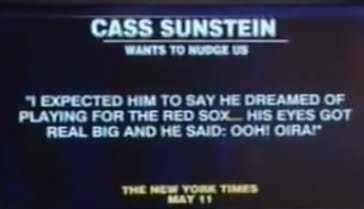
    

Sunstein's Wife asked (when they were dating) what his dream job would be... (The OIRA is the Office Of Information And Regulatory Affairs)

"I expected him to say he dreamed of playing for the Red Sox... his eyes got real big and he said: OOH! O.I.R.A. !" -NYT may 11


__________________________________________________________________________________


__________________________________________________________________________________
Samantha Power; wife of Cass Sunstein,

Advocate of the "Responsibility to Protect" policy


________________________________________
The Most Dangerous Woman In America?  
[Glenn Beck] Wednesday, March 30, 2011

________________________________________


Samantha Power Goes to War by Tom Haydenvia The Nation


Excerpt-

Over a long conversation with Power in December 2003, I was struck by the generational factor in her thinking. If she had experienced Vietnam in her early 20s, I felt, she would have joined the radical left, suspicious always of American power. But as an Irish internationalist witnessing death and destruction in the former Yugoslavia, she wondered how the United States could be neutral. She strongly favored the American intervention and air war that followed. I asked whether she would have favored the Clinton administration sending combat troops to battle the Serbs, a scenario which was in the works when Russia pulled its support from Belgrade, effectively ending that war. I didn’t get an answer, only the promise of “a long conversation” in the future.
Power generalized from her Balkans experience to become an advocate of American and NATO military intervention in humanitarian crises, a position which became known as being a “humanitarian hawk.” She began to see war as an instrument to achieving her liberal, even radical, values. “The United States must also be prepared to risk the lives of its soldiers” to stop the threat of genocide, she wrote. She condemned Western “appeasement” of dictators. She believed that “the battle to stop genocide has been repeatedly lost in the realm of domestic politics.” In her mind, domestic concerns like discrimination and unemployment were secondary to foreign policy crises, a common attitude in the national security circles she was entering.

________________________________________________________________________________
Glenn Beck Show- March 24, 2011
19:10-19:45 - Open Society - defined
20:10 precursor - 21:35 Responsibility to Protect - explained
22:43 Samantha Power - "The Problem from Hell"


________________________________________________________________________________

http://www.freerepublic.com/focus/f-bloggers/2695917/posts________________________________________________________________________________

"Responsibility To Protect" [Wikipedia]

________________________________________________________________________________


Thursday, February 3, 2011

Theodore Roosevelt

Teddy
 Theodore Roosevelt, became President by the assassination of William McKinley, and held office from 1901-1909. He initiated the "Progressive Movement". Modern politics finds much of its origin in the progressive rejection of the principles and constitutionalism of our founding fathers.

TR was the first to use the presidency to promote particular domestic policy initiatives, which originated the term "Bully Pulpit". A perfect example of which is his promotion of the Hepburn Act.
 After his presedincy, he embraced even more, Progressive principles, regarding the role of government; influenced by HerbertCroly and his book The Promise of American Life. Which compelled him to run for president in 1912, and his progressive party platform.

In the mid 1800s, Progressivism was imported from German universities, that were under the influence of Immanuel Kant and Georg Hegel [who articulated ideas of sharp contrast to those of our founding], by German and American students to American universities, beginning with Johns Hopkins University, which established the first graduate program in political science in the US.
Throughout the late 1800s and early 1900s, Progressive Ideas flooded into the mainstream academia as well as culture through Muck Raking Journalism, and the rise of Magazines.
 
___________________________________________________________________________________
[Wikipedia] [Conservapedia]

Corollary to the Monroe Doctrine (1905) - [OurDocuments.gov]
___________________________________________________________

W.I.P.

The Elkins Anti-Rebate Law,
the Department of Commerce,

Hepburn Bill.

National Forest Service -   · The National Forest Service was created during Roosevelt's Presidency to protect and help conserve the National Forests and National Parks in the United States. The service's creation is one example of Roosevelt's policies concerning conservation.
__________________________________________________________________________________


_____________
Quotes:

“The man who wrongly holds that every human right is secondary to his profit must now give way to the advocate of human welfare, who rightly maintains that every man holds his property subject to the general right of the community to regulate its use to whatever degree the public welfare may require it."

"Combinations in industry are the result of an imperative economic law which cannot be repealed by political legislation. The effort at prohibiting all combination has substantially failed. The way out lies, not in attempting to prevent such combinations, but in completely controlling them in the interest of the public welfare."

"Every special interest is entitled to justice full, fair, and complete and, now, mind you, if there were any attempt by mob-violence to plunder and work harm to the special interest, whatever it may be, that I most dislike, and the wealthy man, whomsoever he may be, for whom I have the greatest contempt, I would fight for him, and you would if you were worth your salt. He should have justice. For every special interest is entitled to justice, but not one is entitled to a vote in Congress, to a voice on the bench, or to representation in any public office. The Constitution guarantees protection to property, and we must make that promise good. But it does not give the right of suffrage to any corporation. "


__________________________________________
Theodore "Teddy" Roosevelt's The Man In The Arena Speech at the Sorbonne April 23 1910
Theodore "Teddy" Roosevelt's New Nationalism Aug 31, 1910

______________________

New Nationalism - [blog-LINK]
__________________________________________
The Meat Inspection Act - [blog-LINK]
____________________________________________________________
____________________________________________________________


____________________________________________________________

____________________________________________________________

Friday, December 17, 2010

Nazism

Adolf Hitler
(April 20 1889 – April 30 1945) 
An Austrian-born German politician and the leader of NSDAP, The "Nationalsozialistische Deutsche Arbeiterpartei" or "National Socialist German Workers Party" more commonly known as the Nazi Party.
He was Chancellor of Germany from 1933 to 1945, and from 1934 to 1945 Führer und Reichskanzler.

A decorated veteran of World War I, Hitler joined the precursor of the Nazi Party The DAP, "Deutsche Arbeiterpartei" or "German Workers' Party" in 1919, and became leader of Nazy Party, in 1921. He attempted a failed coup d'etat known as the Beer Hall Putsch, which occurred at the Bürgerbräukeller beer hall in Munich on November 8–9, 1923.

Hitler was imprisoned for one year due to the failed coup, and wrote his memoir, Mein Kampf, while imprisoned. After his release on December 20, 1924, he gained support by promoting Pan-Germanism, anti-semitism, anti-capitalism, and anti-communism with charismatic oratory and propaganda. He was appointed chancellor on January 30, 1933, and transformed the Weimar Republic into the Third Reich, a single-party dictatorship based on the totalitarian andautocratic ideology of Nazism.

Hitler ultimately wanted to establish a New Order of absolute Nazi German hegemony in continental Europe. To achieve this, he pursued a foreign policywith the declared goal of seizing Lebensraum ("living space") for the Aryan people; directing the resources of the state towards this goal. This included the rearmament of Germany, which culminated in 1939 when the Wehrmacht invaded Poland. In response, the United Kingdom and France declared war against Germany, leading to the outbreak of World War II in Europe.[2]

Within three years, German forces and their European allies had occupied most of Europe, and most of Northern Africa, and the Japanese forces had occupied parts of East and Southeast Asia and the Pacific Ocean. However, with the reversal of the Nazi invasion of the Soviet Union, the Allies gained the upper hand from 1942 onwards. By 1944, Allied armies had invaded German-held Europe from all sides. Nazi forces engaged in numerous violent acts during the war, including the systematic murder of as many as 17 million civilians,[3] including an estimated six million Jews targeted in the Holocaust and between 500,000 and 1,500,000 Roma,[4] added to the Poles, Soviet civilians, Soviet prisoners of war, people with disabilities, homosexuals, Jehovah's Witnesses, and other political and religious opponents.

In the final days of the war, during the Battle of Berlin in 1945, Hitler married his long-time mistress Eva Braun and, to avoid capture by Soviet forces, the two committed suicide[5] less than two days later on 30 April 1945.
________________________________________________________________________________

Godwin's Law

Reductio ad Hitlerum:

______________________________________________
Quotes

"The best thing is to let Christianity die a natural death...."

"Our epoch Uin the next 200 yearse will certainly see the end of the disease of Christianity.... My regret will have been that I couldn't..."

here's a hitler youth chant "We are the joyous Hitler youth, We do not need any Christian virtue"
______________________________________________________________________________

a press release from Catholic League President, William A. Donohue (2/4/99): "Hitler was a neo-pagan terrorist whose conscience was not informed by Christianity, but by pseudo-scientific racist philosophies. Hitler hated the Catholic Church, made plans to kill the Pope, authorized the murder of thousands of priests and nuns, and did everything he could to suppress the influence of the Church. In 1933, Hitler said, 'It is through the peasantry that we shall really be able to destroy Christianity because there is in them a true religion rooted in nature and blood.'"  The Catholic League also quoted Hitler, in a 4/23/99 Op-Ed ad in the New York Times, as saying, "Antiquity was better than modern times, because it didn't know Christianity and syphilis." Ouch!

Hitler: A Study in Tyranny, by Allan Bullock, as saying: "I'll make these damned parsons feel the power of the state in a way they would have never believed possible. For the moment, I am just keeping my eye upon them: if I ever have the slightest suspicion that they are getting dangerous, I will shoot the lot of them. This filthy reptile raises its head whenever there is a sign of weakness in the State, and therefore it must be stamped on. We have no sort of use for a fairy story invented by the Jews."

Hitler's secretary, Martin Bormann, also declared that "National Socialism [Nazism] and Christianity are irreconcilable" and Hitler didn't squawk too much about it.

Hermann Rauschning, a Hitler associate, said, "One is either a Christian or a German. You can't be both."

Hitler declared Nazism the state religion and the Bible was replaced by Mein Kampf in the schools.
__________________________________________________________________________

http://homepages.paradise.net.nz/mischedj/ca_hitler.html

Friday, November 12, 2010

George Soros

Wikipedia: George Soros

Discover The Networks: George Soros
  • Multi-billionaire funder of leftwing causes and groups
  • Founder of the Open Society Institute  
  • Stated that defeating President Bush in the 2004 election "is the central focus of my life"

http://www.theblaze.com/stories/the-puppet-master-read-the-beck-tv-background-guide-to-george-soros/


Soros Quotes:
 "It is sort of a disease when you consider yourself some kind of god, the creator of everything, but I feel comfortable about it now since I began to live it out." The Independant June 3, 19X3

Sunday, October 17, 2010

Depressions

The Long Depression, The Depression of 1920, The Great Depression, and The Great Recession 
__________________________________________________________________________________
_______________________________________
The Long Depression
The Original "Great Depression" 1873-1896 
_____________________________________________________________
History of Money and Banking in the United States by Murray Rothbard [free PDF ebook]
[This refers solely to America]
pg 154
Orthodox economic historians have long complained about the “great depression” that is supposed to have struck the United States in the panic of 1873 and lasted for an unprecedented six years, until 1879. Much of this stagnation is supposed to have been caused by a monetary contraction leading to the resumption of specie payments in 1879. Yet what sort of “depression” is it which saw an extraordinarily large expansion of industry, of railroads, of physical output, of net national product, or real per capita income? As Friedman and Schwartz admit, the decade from 1869 to 1879 saw a 3-percent-perannum increase in money national product, an outstanding real national product growth of 6.8 percent per year in this period, and a phenomenal rise of 4.5 percent per year in real product per capita. Even the alleged “monetary contraction” never took place, the money supply increasing by 2.7 percent per year in this period. From 1873 through 1878, before another spurt of monetary expansion, the total supply of bank money rose from $1.964 billion to $2.221 billion—a rise of 13.1 percent or 2.6 percent per year. In short, a modest but definite rise, and scarcely a contraction. It should be clear, then, that the “great depression” of the 1870s is merely a myth—a myth brought about by misinterpretation of the fact that prices in general fell sharply during the entire period. Indeed they fell from the end of the Civil War until 1879. Friedman and Schwartz estimated that prices in general fell from 1869 to 1879 by 3.8 percent per annum. Unfortunately, most historians and economists are conditioned to believe that steadily and sharply falling prices must result in depression: hence their amazement at the obvious prosperity and economic growth during this era. For they have overlooked the fact that in the natural course of events, when government and the banking system do not increase the money supply very rapidly, freemarket capitalism will result in an increase of production and economic growth so great as to swamp the increase of money supply. Prices will fall, and the consequences will be not depression or stagnation, but prosperity (since costs are falling, too) economic growth, and the spread of the increased living standard to all the consumers.
http://blog.mises.org/13120/krugman-and-the-long-depression-myth/ 
_______________________________________________________

http://blog.mises.org/9790/the-truth-about-the-depression-of-the-1870s/
http://mises.org/Community/forums/t/18479.aspx

http://mises.org/daily/3788
http://en.wikipedia.org/wiki/Long_Depression
__________________________________________________________________________________
The Depression of 1920


__________________________________________________________________________________
______________________________________
The Great Depression

Great Depression Playlist


[Uncommon_Knowledge_Amity_Shlaes]


[Amity_Shlaes_A_New_History_of_the_Great_Depression]
 
____________________________________________________
 
The Forgotton Man by Amity Shlaes [Excerpts Thereof]

Title Page, The Forgotten Man Essay by William Graham Sumner
pg 1, Introduction: William Troeller, just one story, in a city of troubled stories.
pg 99-100, Herbert Hoover, Richard Whitney, and Short Selling, an essential gamble

____________________________________________________


The Global Impact of the Great Depression, 1929-1939 by Dietmar Rothermund [Google Books.com]

THE TRANSMISSION OF THE CRISIS TO EUROPE pg 59
The depression was transmitted from America to Europe in 1930. The stock market crash of October 1929 did not have an immediate effect on Europe. On the contrary, financial circles could heave a sigh of relief as they were no longer threatened by the rush of funds to New York. Discount rates which had been raised to counteract that flow could be lowered once more and this eased the strain on European financial markets. From 1925 to the beginning of 1929 the discount rate of the Bank of England had stood at about 4.5 per cent. By September 1929 it had been raised to 6.5 per cent. Immediately after the crash it was reduced to 6 per cent. It was then lowered bit by bit until it stood at 2.5 per cent in May 1931. In France a new generous programme of state expenditure was announced only a few weeks after the crash. But this was not done in wise anticipation of the impending crisis, but only because France had consolidated its currency and was in a very comfortable financial position. It could afford such a programme now, and nobody thought of a crisis.
Germany faced an impending bankruptcy at that time which was entirely unrelated to the events in America. The German government was under political pressure to cut taxes, but on the other hand it could no longer place long term government bonds and thus depended on short term credit. In this context the lowering of the discount rate after the crash was very welcome to the government. In subsequent years Germany faced a crisis of a special kind which will be analysed in the respective section of this chapter. At this stage these statements may suffice to show that the crash of 1929 did not mark the beginning of the depression in Europe. The mechanism of the transmission of the depression was much more complex. Europe was affected only after a considerable... [continued on page 60] -
time lag. In order to reconstruct the process of transmission we shall present four case studies: Great Britain, Germany, France and Sweden, the latter so as to illustrate a very special instance of successful crisis management.
______________________________
Henry Morgenthau, Jr. [Wikipedia]
FDR's Treasury Secretary

"We have tried spending money. We are spending more than we have ever spent before and it does not work. And I have just one interest, and if I am wrong … somebody else can have my job. I want to see this country prosperous. I want to see people get a job. I want to see people get enough to eat. We have never made good on our promises. … I say after eight years of this Administration we have just as much unemployment as when we started. … And an enormous debt to boot."
__________________________________________________________________________________
The Great Recession

Liberty and Tyranny by Mark R. Levin Excerpts 

pg82
__________________________________________________
   A. What belongs to no one is wasted by everyone
   B. Statist's rationalizing Loophole around property rights
       "The Public Good"
Four Events that led to the Housing Bust of '08 
   EVENT 1: The CRA of 1977
__________________________________________________

____________________________________________________
EVENT 2: HUD pressures Govt Chartered Freddie and Fannie to encourage risky loans
   EVENT 3: Govt Intervention/Social Engineering produces the "Derivative"/Speculation Market 
   EVENT 4: The Federal Reserve slashes interest rates from 2001's at 6.5% to 2006's at 1%
 ____________________________________________________

________________________________________________________________________________

The Scope of the Bailout/Stimulus


______________________________________________________________________________

http://youtu.be/MAewKx7wx0c


http://goo.gl/XbQKI
 
______________________________________________________________________________
______________________________________________________________________________

The Inflationist View of History -http://mises.org/daily/4143 
______________________________________________________________________________
After having skimmed these sources to respond to a comment; now I actually need to do my homework; which is to organize this into comprehensive knowledge for reference [IE my own memory trigger/vault]

http://en.wikipedia.org/wiki/Herbert_Hoover#Great_Depression

http://mises.org/daily/3788

http://en.wikipedia.org/wiki/Herbert_Hoover#Great_Depression

http://www.federalreserve.gov/boarddocs/speeches/2004/200403022/default.htm

http://en.wikipedia.org/wiki/Great_Depression#Effects

http://en.wikipedia.org/wiki/Depression_of_1920%E2%80%9321#Monetary_policy

http://www.youtube.com/watch?v=9V5OP-VmXgE

http://en.wikipedia.org/wiki/Depression_of_1920%E2%80%9321#Monetary_policy
___________________________
__________________________________________________________________________________

Fannie, Freddie, and the Subprime Mortgage Market

http://www.cato.org/pub_display.php?pub_id=12846

Friday, August 20, 2010

The Union of Soviet Socialist Republics

The Soviet Union (Wikipedia)

Communism (Wikipedia)

Leninism (Wikipedia)

Stalinism (Wikipedia)

The Soviet Holocaust

"The Revolutionary Holocaust" via WatchGlennBeck.com

"The Soviet Story" via Viddler.com

Constitutions of USSR
The Brezhnev Constitution (InBlog)

Belavezha Accords (Wikipedia)
__________________________________________________________________________________
______________________________________________________

BOOKS
______________


Communist Manifesto by Karl Marx and Frederick Engels (Free Online eBook)


Blacklisted by History: The Untold Story of Senator Joe McCarthy by M. Stanton Evans


The Dead Hand: The Untold Story Of The Cold War Arms Race And Its Dangerous Legacy by David E. Hoffman


Know Your Enemy: The Rise and Fall of America's Soviet Experts by David C. Engerman


Lenin, Stalin, And Hitler by Robert Gellately


THE RED NETWORK; A "WHO'S WHO" AND HANDBOOK OF RADICALISM FOR PATRIOTS by Elizabeth Kirkpatrick Dilling 1894-1966 (Free eBook)


Soviet Fates And Lost Alternatives by Stephen F. Cohen


_________________

Saturday, July 31, 2010

Walter Lippmann

Father of Modern Journalism
Author of "Phantom Public", "Liberty and the News" (1920), and "The Promise of American Life" [September 23 1889 – December 14 1974], American intellectualwriterreporter, and political commentator who gained notoriety for the introduction of the concept of "Cold War" for the first time in the world. Lippmann was twice awarded (1958 and 1962) aPulitzer Prize for his syndicated newspaper column, “Today and Tomorrow”.


In 1913, Lippmann, Herbert Croly, and Walter Weyl became the founding editors of The New Republic magazine. During World War I, Lippmann became an adviser to President Woodrow Wilson and assisted in the drafting of Wilson's Fourteen Points speech.


Lippmann had wide access to the nation's decision makers and had no sympathy for communism. After Lippmann had become famous, theGolos spy ring used Mary Price, his secretary, to garner information on items Lippmann chose not to write about or names of Lippmann's sources, often not carried in stories, but of use to the Soviet Ministry for State Security.


He and Charles Merz, in a 1920 study entitled A Test of the News, stated thatThe New York Times' coverage of the Bolshevik revolution was biased and inaccurate. In addition to his Pulitzer Prize-winning column "Today and Tomorrow," he published several books. Lippmann was the first to bring the phrase "cold war" to common currency in his 1947 book by the same name.


e argued that people—including journalists—are more apt to believe "the pictures in their heads" than come to judgment by critical thinking. Humans condense ideas into symbols, he wrote, and journalism, a force quickly becoming the mass media, is an ineffective method of educating the public. Even if journalists did better jobs of informing the public about important issues, Lippmann believed "the mass of the reading public is not interested in learning and assimilating the results of accurate investigation." Citizens, he wrote, were too self-centered to care about public policy except as pertaining to pressing local issues.
Lippmann saw the purpose of journalism as "intelligence work". Within this role, journalists are a link between policymakers and the public. A journalist seeks facts from policymakers which he then transmits to citizens who form a public opinion. In this model, the information may be used to hold policymakers accountable to citizens. This theory was spawned by the industrial era and some critics argue the model needs rethinking inpost-industrial societies.
Though a journalist himself, he held no assumption of news and truth being synonymous. For him the “function of news is to signalize an event, the function of truth is to bring to light the hidden facts, to set them in relation with each other, and make a picture of reality on which men can act.” A journalist’s version of the truth is subjective and limited to how he constructs his reality. The news, therefore, is “imperfectly recorded” and too fragile to bear the charge as “an organ of direct democracy.”
To his mind, democratic ideals had deteriorated, voters were largely ignorant about issues and policies, they lacked the competence to participate in public life and cared little for participating in the political process. In Public Opinion (1922), Lippmann noted that the stability the government achieved during the patronage era of the 1800s was threatened by modern realities. He wrote that a “governing class” must rise to face the new challenges. He saw the public as Plato did, a great beast or a bewildered herd – floundering in the “chaos of local opinions."
The basic problem of democracy, he wrote, was the accuracy of news and protection of sources. He argued that distorted information was inherent in the human mind. People make up their minds before they define the facts, while the ideal would be to gather and analyze the facts before reaching conclusions. By seeing first, he argued, it is possible to sanitize polluted information. Lippmann argued that seeing through stereotypes (which he coined in this specific meaning) subjected us to partial truths. Lippmann called the notion of a public competent to direct public affairs a "false ideal." He compared the political savvy of an average man to a theater-goer walking into a play in the middle of the third act and leaving before the last curtain.
Early on Lippmann said the herd of citizens must be governed by “a specialized class whose interests reach beyond the locality." This class is composed of experts, specialists and bureaucrats. The experts, who often are referred to as "elites," were to be a machinery of knowledge that circumvents the primary defect of democracy, the impossible ideal of the "omnicompetent citizen". Later, in The Phantom Public (1925), he recognized that the class of experts were also, in most respects, outsiders to any particular problem, and hence, not capable of effective action. Philosopher John Dewey (1859–1952) agreed with Lippmann's assertions that the modern world was becoming too complex for every citizen to grasp all its aspects, but Dewey, unlike Lippmann, believed that the public (a composite of many “publics” within society) could form a “Great Community” that could become educated about issues, come to judgments and arrive at solutions to societal problems.
Following the removal from office of Henry A. Wallace in September 1946, Lippmann became the leading public advocate of the need to respect a Soviet sphere of influence in Europe, as opposed to the containment strategy being advocated at the time by people like George F. Kennan.
Lippmann was an informal adviser to several presidents.[citation needed] He had a rather famous feud with Lyndon Johnson over his handling of the Vietnam War, of which Lippman had become highly critical.[citation needed]
On September 14, 1964, President Johnson presented Lippmann with the Presidential Medal of Freedom.
A meeting of intellectuals organized in Paris in August 1938 by French philosopher Louis RougierColloque Walter Lippmann was named after Walter Lippmann. Walter Lippmann House at Harvard University, which houses the Nieman Foundation for Journalism, is named after him too. Noam Chomsky and Edward S. Herman used one of Lippmann's catch phrases, the "Manufacture of Consent" for the title of their book, Manufacturing Consent, which contains sections critical of Lippmann's views about the media.


Bibliography

With William O. Scroggs

__________________________________________________________________________________

QUOTES
__________________________________________________________________________________

"News and truth are not the same thing..." -Public Opinion (1922)

"The common interests, very largely, elude public opinion entirely, and can be managed only by a specialized class whose personal interests reach beyond the locality." -Public Opinion (1922)

"When men can no longer be theists, they must, if they are civilized, become humanists." 

"When distant and unfamiliar and complex things are communicated to great masses of people, the truth suffers a considerable and often a radical distortion. The complex is made over into the simple, the hypothetical into the dogmatic, and the relative into an absolute."

"The great social adventure of America is no longer the conquest of the wilderness but the absorption of fifty different peoples." 

"There is no arguing with the pretenders to a divine knowledge and to a divine mission. They are possessed with the sin of pride, they have yielded to the perennial temptation."

"Unless the reformer can invent something which substitutes attractive virtues for attractive vices, he will fail." 

"We are all captives of the picture in our head - our belief that the world we have experienced is the world that really exists."

"What we call a democratic society might be defined for certain purposes as one in which the majority is always prepared to put down a revolutionary minority." 

"Brains, you know, are suspect in the Republican Party." 

"Industry is a better horse to ride than genius." 

"It is perfectly true that that government is best which governs least. It is equally true that that government is best which provides most." 

"It requires wisdom to understand wisdom: the music is nothing if the audience is deaf." 

"It does not require wisdom to understand wisdom, merely average faculties; if a wise-man's audience cannot understand him he will find a mode of communication, a wise man will surely not just carry on headless and regardless" -Asderathos

"Men who are orthodox when they are young are in danger of being middle-aged all their lives." 

"Most men, after a little freedom, have preferred authority with the consoling assurances and the economy of effort it brings." 

"Once you touch the biographies of human beings, the notion that political beliefs are logically determined collapses like a pricked balloon."

"Only the consciousness of a purpose that is mightier than any man and worthy of all men can fortify and inspirit and compose the souls of men." 

"Our conscience is not the vessel of eternal verities. It grows with our social life, and a new social condition means a radical change in conscience."